
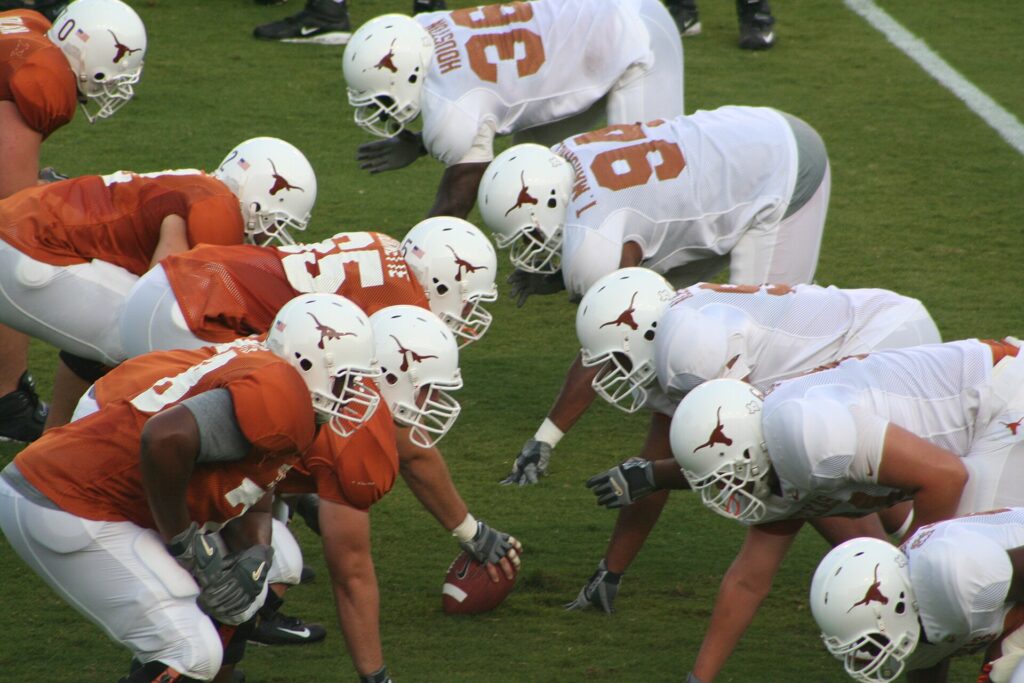
A Down Is the Basic Unit That Gives American Football Its Shape
People new to American football often understand the collisions before they understand the structure. They see a snap, a tackle, a whistle, and then a long pause while everyone resets. The word that organizes all of that is down. A down is one play from scrimmage. The ball is snapped, the offense tries to advance it, the defense tries to stop it, and when the play ends the offense has used one of its chances in that series.
That sounds simple, but the whole sport changes once you understand what a down really does. It turns the game into a contest of planning, pressure, and territory. Every offense gets a limited number of plays to gain ground. Every defense knows the offense becomes more predictable as those plays disappear. So a down is not just a number the broadcast shows on screen. It is the clock inside each possession.
The Four-Down System Explains Why Teams Cannot Drift Forever
An offense normally gets four downs to gain ten yards. If it succeeds, the reward is a new set of four downs. That is why you hear phrases like first-and-ten, second-and-six, or third-and-two. The first number tells you which attempt the offense is on. The second number tells you how many yards remain before it earns another set. This system prevents a team from keeping the ball forever without making progress. It has to keep moving the chains.
The game is divided into these short tactical missions. Gain enough, and the drive stays alive. Fall short, and the pressure builds quickly. What looks to a beginner like a small three-yard run can actually be a successful first-down play because it makes the rest of the series easier.
First Down Is Opportunity, Second Down Is Adjustment
First down gives the offense the most freedom. Because it has all four chances available, the playbook stays open. The offense can run, throw short, throw deep, use motion, or take a calculated risk without feeling cornered. Coaches want first down to create momentum because a good gain there changes everything that follows. Five yards on first down can make the next call comfortable. A loss of three can make the series feel tense almost immediately.
Second down is where the drive begins to reveal itself. If the first play worked, second down can be used creatively to attack a defense that is off balance. If the first play failed, second down becomes a recovery point. This is why commentators often call second and short a favorable situation. The offense can afford to be aggressive because it still has room for error. Second and long is different. The defense can start anticipating that the offense needs more yardage than it would like.
Third Down Is Pressure, Not Because It Is Magical but Because It Is Narrow
Third down carries drama because options shrink. If a team fails again, it is usually staring at fourth down, where the risk of turning the ball over on downs becomes real. That is why third down is treated like a defining moment in a drive. The defense knows one good stop can end the possession. The offense knows one precise execution can reset everything.
This is also where situational football becomes obvious. Third and one may invite a power run or a quarterback sneak. Third and twelve often pushes the offense toward a pass concept designed to reach the sticks. Defenses adjust accordingly, changing coverage, pass rush, and alignment based on the distance needed. So when people say a team is good on third down, they usually mean it stays calm and efficient when the play must match the situation exactly.
Fourth Down Is a Decision About Risk and Field Position
Many beginners assume teams always use all four downs in the same way. They do not. Fourth down is often less about the play itself and more about the consequences if it fails. If an offense goes for it and comes up short, the other team gets the ball at that spot. That can be costly, especially if the offense is deep in its own territory. Because of that, teams frequently punt on fourth down to push the opponent farther away, or attempt a field goal if they are close enough.
But modern strategy has made fourth down more interesting. Coaches are more willing than before to go for it in the right context, especially on fourth and short or when game state demands aggression. The key point is that fourth down is a choice point. It asks whether keeping the drive alive is worth the danger of handing over excellent field position.
Down and Distance Tell You More Than the Score Sometimes
Casual viewers often focus only on who is winning, but down and distance can tell you who is actually in control of a sequence. First and ten at midfield feels balanced. Second and eighteen is a defensive win even if no points have been scored yet. Third and goal at the two-yard line is a chance, but also a moment of stress because the field is compressed and the defense has less space to protect.
This is why coaches obsess over staying ahead of the chains. They want manageable downs where the offense can still threaten multiple outcomes. Once a team keeps landing in obvious passing situations, the defense can attack with more confidence. The scoreboard matters in the end, but the down often explains why the scoreboard is moving in one direction.
Some People Confuse a Down With a Possession or a Quarter
A down is not a whole drive, and it is not a whole section of the game. A possession can contain many sets of downs if the offense keeps gaining enough yards. A quarter is just a time segment of the match. The down is much smaller than either one. It is one attempt, one snap, one contained battle. That is why a single penalty, sack, or missed throw can completely change the emotional texture of a drive. It changes the next down.
Another common misunderstanding is thinking the offense must score within four downs every time. It does not. It only needs to gain ten yards within that set to refresh the count.
The Defense Treats Every Down Differently Too
Defensive football is not just about reacting. It is about anticipating the offense based on down. On first down, a defense may want to prevent an easy rhythm play. On second and long, it may expect a safer throw or a draw run. On third and medium, it may design pressure to force the ball out before the receivers reach the marker. The best defenses understand that a three-yard gain does not mean the same thing on every down.
This is why a strong defense can make an offense feel trapped without necessarily producing huge highlights on every play. If it wins first down and keeps the offense uncomfortable on second down, it turns third down into an obvious, stressful test. In other words, the defense is also trying to manage the story of the downs, not just the result of one tackle.
Understanding Downs Makes the Sport Far Easier to Read
American football can look slow or overcomplicated to a newcomer because the action is broken into so many separate moments. The down system is what ties those moments together. It gives each snap a purpose and gives each result a consequence. A five-yard completion is not just five yards. It is five yards on a particular down, in a particular area of the field, against a particular strategic backdrop.
Once you start reading the game that way, the sport becomes much clearer. You stop seeing isolated plays and start seeing sequences. You understand why coaches celebrate a modest run on first down, why a sack on third down feels so crushing, and why a decision on fourth down can define the entire game. A down is only one play, but it is the piece that makes every other part of American football connect.
📚 From the Blog



Image credit: No machine-readable author provided. Johntex~commonswiki assumed (based on copyr / Wikimedia Commons (CC BY 2.5)