
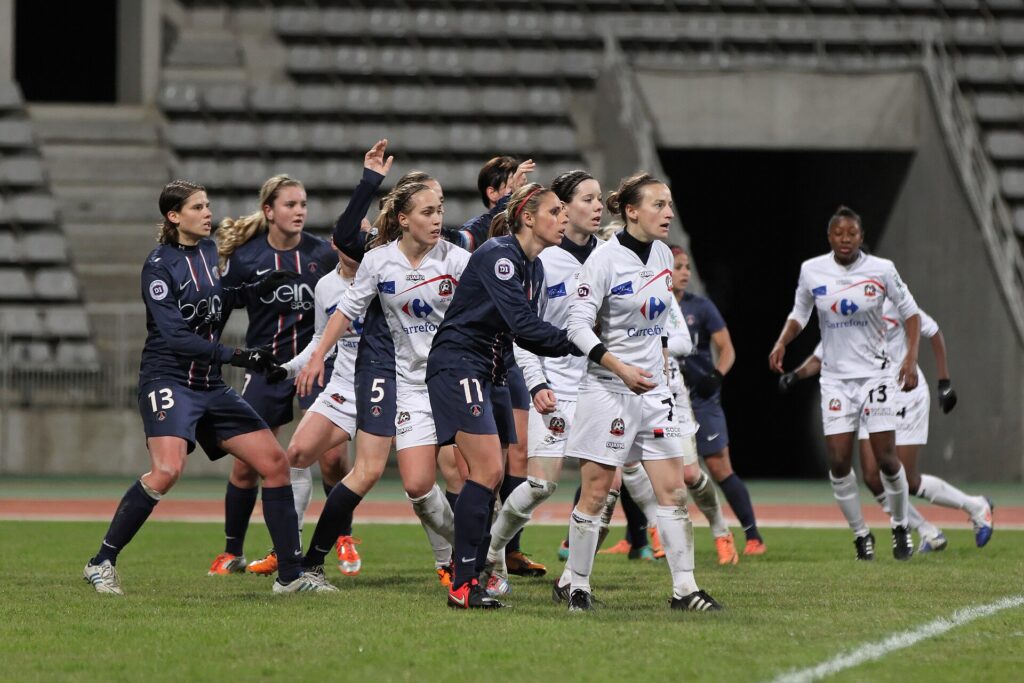
A curling free kick is one of football’s most satisfying sights because it looks impossible until you understand what created it. The ball starts outside the post, bends around the wall, then drops back into the goal so late that the goalkeeper seems stranded. What makes the strike special is not mystery. It is control over contact, spin and body shape.
Most players fail with curved free kicks for the same reason they fail with many advanced techniques: they jump straight to the spectacular part and skip the basics. They think about the bend before they think about the plant foot, the strike zone on the ball or the pace needed to beat the goalkeeper. The curve only matters if the rest of the strike is stable enough to let that spin work.
The bend comes from spin, not from trying to steer the ball in the air
A football curves because spin changes the airflow around it. For a right-footed player curling the ball from left to right, the strike needs to brush across the outside of the ball so it rotates in the direction that drags it back towards goal. A left-footer creating the mirror image does the same thing from the opposite side.
The important practical point is that the kick is not a scoop. Players who try to lift and wrap the foot too much often produce a weak shot with plenty of shape but not enough speed. A useful free kick needs both elements: enough pace to trouble the goalkeeper and enough spin to change the flight.
Start with the ball position and the angle
Your angle to the ball affects the path of the swing and the amount of cut you can apply. Many players strike a curling free kick from a slight side angle rather than a straight-on approach. That angle gives the hips room to come around the ball and makes it easier to contact the outer half without jamming the leg path.
The ball itself should feel set rather than rushed. If the turf or the match ball is poor, you may need to simplify the attempt and go more for firm placement than exaggerated bend. One mark of a mature free-kick taker is knowing when the conditions do not justify the glamorous option.
Where on the ball to make contact
For an inswinging curl, the contact is usually slightly off-centre rather than dead through the middle. Hit too centrally and the ball flies straighter. Hit too far around the side and you may create spin but lose speed and height control. The aim is a strike that still goes through the ball while brushing enough across it to create the bend.
Players often imagine this as “wrapping” the foot around the ball, but the better mental image is cutting through one side of it with a committed swing. The strike should still be decisive. A timid touch rarely generates the right flight.
The standing foot determines whether the shot rises, dips or drifts
Free-kick technique is full of discussions about foot shape, but the standing foot quietly controls much of the outcome. Plant too far behind the ball and you tend to lift it too much. Plant too close and the swing becomes cramped. Plant too far to the side and the contact point becomes inconsistent.
For most curling attempts, the standing foot should be stable and slightly offset in a way that allows the kicking leg to come across the ball naturally. The upper body then needs to stay over the strike for long enough to stop the shot floating. If you fall back too soon, the ball will often climb over both the wall and the crossbar.
Height matters as much as direction
A well-curved free kick still has to solve the wall. Too low, and it crashes into the first defender. Too high, and the goalkeeper has time to recover because the bend has started from too slow and too lofty a path. That is why great free-kick takers are not just curve artists; they are trajectory artists.
The best attempts clear the wall by a manageable margin, then begin to drop and bend quickly. That is where repetition matters. You are not learning one movement. You are learning how much lift your particular technique naturally produces, then adjusting the contact and follow-through around that pattern.
Power and curl are a trade-off, not enemies
Players often think they must choose between a hard shot and a bending shot. In reality, the aim is to find the right balance for the distance and angle. From closer range, heavier spin and a bit less pace may be enough because the keeper has less reaction time. From further out, the shot often needs more direct pace or it will bend beautifully into a catching height.
This is why not every free kick should be struck the same way. A central free kick just outside the box invites one type of technique. A wider angle, where you are trying to curl across the goalkeeper into the far post, invites another. The player who understands the geometry of the situation usually makes better choices than the player who always tries to recreate one famous goal.
Know when the wall changes the correct option
Not every set piece asks for the same solution. Sometimes the wall is tall and close enough that the obvious bend is unrealistic. Sometimes the goalkeeper is cheating to one side. Sometimes the safer percentage play is a driven shot under a jumping wall, or a disguised pass to another runner rather than a direct strike.
This matters because a good free-kick taker is also a good free-kick reader. Technique should serve the decision, not replace it. The highlight-reel curler is only the right idea when the angle, wall and goalkeeper positioning actually allow it.
Your body should finish through the strike, not away from it
Many poor free kicks come from trying to manufacture curl with the upper body instead of the foot. The player leans dramatically, whips the torso around and loses the line of the shot before contact is complete. The ball may spin, but it rarely flies with authority.
A cleaner finish usually comes when the body travels through the strike with enough balance to keep the contact strong. The follow-through can move across the body, but it should look like the natural continuation of a committed swing rather than a theatrical attempt to force shape onto the ball.
Practice should isolate one variable at a time
Players trying to learn the technique often change everything at once: run-up, contact point, pace and target. That makes improvement slower because there is no stable base to judge from. A better method is to keep one element fixed and work on another. For example, hold the angle constant and experiment with where on the ball the foot lands. Or keep the target area constant and vary the pace.
Even simple marker drills help. Use mannequins or cones as a wall, choose a realistic start line for the ball, and practice sending it over and around the obstacle into one half of the goal rather than trying to pick out postage stamps from the start. Accuracy grows from repeatable medium-success, not from heroic failure.
The technique changes if you are crossing instead of shooting
One useful misunderstanding to clear up is that the same swing can be used for both a shot and a delivery. A curling cross or deep free kick may use similar spin principles, but the intention is different. You are hanging the ball into a dangerous area rather than beating the goalkeeper directly. The strike can therefore be softer, the arc higher and the target broader.
When players confuse those two jobs, they often overhit crossing opportunities or underhit shots. The technique should reflect the purpose of the set piece.
Why great free-kick takers look so repeatable
Watch elite specialists and the striking detail changes less than people think. Their routines are economical. They approach from familiar angles, plant almost the same way every time and trust the contact they have trained. The visual drama comes from the ball flight, not from a noisy run-up.
That repeatability is the real lesson for most players. Curl is not a trick to be reinvented every week. It is a refined version of ordinary striking mechanics, sharpened until the ball leaves the foot with both authority and shape.
Wrapping up
Curving a free kick well is about striking with intention rather than hope. The bend comes from controlled spin, the danger comes from balanced contact, and the success of the shot depends on reading the angle, the wall and the goalkeeper before the run-up even begins. Once those pieces are in place, the beautiful part takes care of itself. The ball bends because the strike deserves to bend, not because the player wished it would.
📚 From the Blog
Image credit: Pierre-Yves Beaudouin / Wikimedia Commons (CC BY-SA 3.0)