
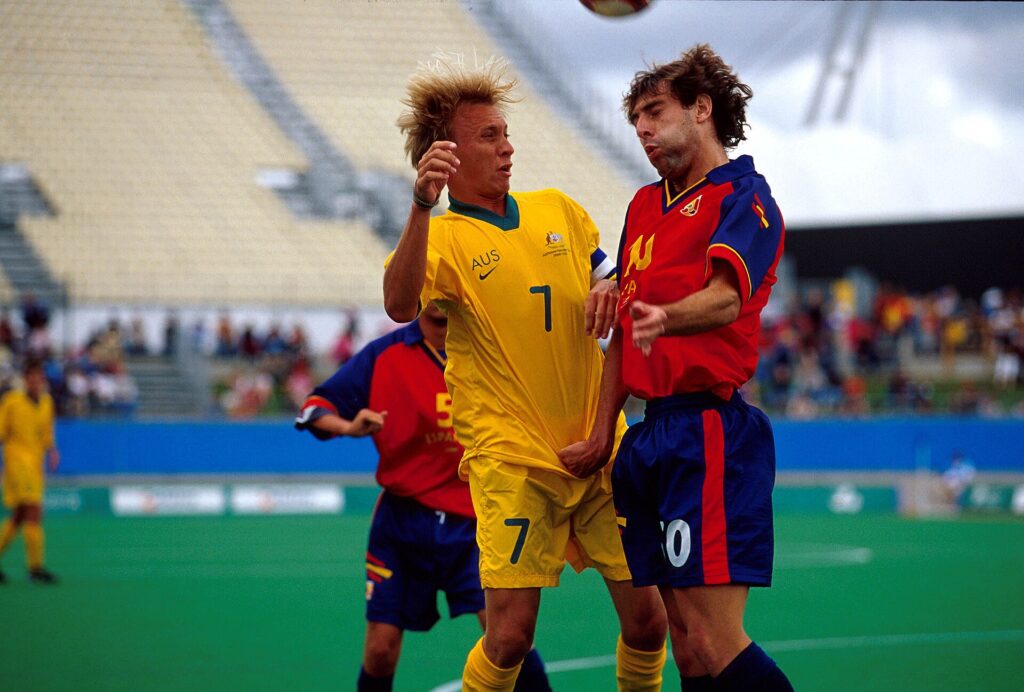
People talk about heading as if it is either natural or frightening, but most of the difference comes down to technique. A well-timed header struck with the right part of the forehead feels clean and purposeful. A mistimed one hit with the top of the head, the face or a tense neck feels ugly and confirms every fear a player had beforehand. That is why good coaching matters. Heading is not just bravery in the air. It is a taught skill.
It is also a skill that now has to be discussed honestly. Modern football knows more about head injury risk than it used to, especially for children and repeated unnecessary heading in training. So learning to head properly means two things at once: understanding the mechanics that make the action effective, and understanding the safety limits that make it responsible.
The forehead is the striking surface, not the top of the skull
The safest and strongest part of the head for directing a football is the firm area across the forehead, roughly around the hairline. That zone lets you meet the ball with a solid surface and send it where you intend. When players say a header hurt, the ball was often struck with the wrong area or while the neck and eyes lost control of the action.
Using the top of the head usually glances the ball upward. Using the nose or face is not really heading at all; it means the player has mistimed the flight and let the ball arrive too deep on them. Good heading starts with getting the body into a position where the forehead can lead the contact.
The neck matters more than many players realise
A header is not produced by the head alone. The neck and upper body create the firmness that makes the contact useful. If the neck is loose and the player simply lets the ball hit them, the result is weak and uncontrolled. If the neck is braced at the right moment and the torso moves through the action, the ball can be directed with surprising accuracy.
This does not mean violently jerking the head. The motion is usually shorter and cleaner than beginners expect. Think of the body moving to meet the ball and the neck holding a strong line through impact. Power often comes from the jump, timing and body movement far more than from some dramatic snapping motion.
Keep the eyes open and judge the flight early
Closing the eyes is one of the classic heading problems. It makes contact feel less intimidating for a split second, but it destroys timing and direction. The player loses sight of the exact point of impact, so the ball arrives unexpectedly and the header becomes reactive.
The answer is not simply “be brave.” It is to read the flight earlier. Track the ball off the foot or cross, move into line with it, then keep the eyes fixed as it approaches. Fear tends to grow when the ball seems to appear late. Good early tracking makes the whole action calmer.
Jump timing is often the real skill
Many players think heading quality is mainly about the contact moment, but the jump often decides everything. Go too early and you are descending when the ball arrives. Go too late and the ball passes over or behind you. The best headers are usually made by players who time their rise so contact happens at or near the top of the leap, when the body is stable and the forehead can meet the ball squarely.
This is especially important in contests with another player. A well-timed leap creates both reach and protection because the body is organised. A mistimed leap leaves you stretching awkwardly and trying to invent the header from a compromised position.
Attacking headers and defensive headers are different jobs
An attacking header is often about direction, glance and disguise. In the box you may only need the smallest touch to redirect a cross beyond the goalkeeper. Sometimes the best attacking header is not a thunderous contact but a subtle one that changes the line of the ball late.
A defensive header usually demands something else. Clear height, distance and first contact matter more than elegance. A full-blooded clearance from the middle of the box should prioritise getting the ball away from danger and out of the crowded area. That is why defenders are taught to attack the ball early and head through it with conviction rather than trying to place it delicately.
Body position decides whether the header goes where you want
If your body is under the ball and leaning back, the header tends to rise. If you get above or level with the line of the ball and drive through it, the header stays firmer and more controlled. This is why coaches tell players to attack the ball rather than wait for it. Passive headers usually float. Active headers usually travel.
Arm use matters too. Not for pushing opponents, but for balance and space. A player who jumps with the arms frozen often loses coordination. A player who uses them naturally to rise and hold position is far more likely to make clean contact.
Heading from crosses is about angles, not just courage
Crosses are rarely delivered straight onto the forehead at a comfortable speed. Some arrive behind the runner, some dip sharply, some hang too long, and others flash across goal so quickly that only a glance is possible. Learning to head from crosses therefore means learning different kinds of contact.
A near-post run may call for a flick across goal. A far-post chance may need the player to head back where the ball came from. A central cross may allow the classic downward header, which is so hard for goalkeepers because the bounce changes the save. Good attackers do not use one heading technique for every cross. They adapt the contact to the angle and pace.
Safety rules for young players are part of good technique
Any modern discussion of heading has to include age and exposure. In youth football, different governing bodies now limit or delay heading practice because developing players need protection from repeated impact, even when single contacts seem harmless. That does not mean heading is forbidden forever. It means training must be age-appropriate and purposeful rather than casual.
For younger players, the priority should be flight judgment, body shape, jumping mechanics and confidence under the ball before repeated heading drills become common. Even with older players, there is little value in pointless volume. Ten thoughtful, well-coached repetitions teach more than endless aimless heading.
Confidence grows through preparation, not force
Players who fear heading are often told to “just attack it harder.” That is usually poor advice. Confidence comes from smaller, controllable steps: using softer serves or underarm tosses in practice, learning the forehead contact point, getting used to tracking the ball, then gradually increasing pace and realism.
Once the player learns what correct contact feels like, the fear often drops quickly because the ball stops seeming random. The uncertainty hurts more than the action itself. Technique removes uncertainty.
The common mistakes are all related
Most bad headers come from the same connected chain: poor read of the flight, late movement, eyes closing, wrong contact point, and a body that is leaning away from the ball. That is why coaching heading as a single isolated motion rarely works. The movement before impact and the body shape at impact matter just as much as the instant of contact.
If a player keeps glancing the ball upward, look at whether they are arriving underneath it. If contact stings, check whether they are using the forehead or the softer areas of the face and scalp. If the header has no power, check whether they are attacking the ball or merely letting it strike them.
Why heading still matters in modern football
Even in an era of short passing and intricate build-up, heading remains decisive. Teams still defend crosses, attack set pieces, clear second balls and fight for long diagonals. Full-backs, centre-backs, central forwards and even midfielders all need some competence in the air because matches continue to turn on aerial moments.
What has changed is that the skill is now taught with more precision and more caution. That is a good thing. Football does not need players recklessly heading everything. It needs players who understand when to head, how to head, and how to train the skill responsibly.
Wrapping up
Heading properly is a mix of timing, body position, eye contact with the ball and clean forehead contact, reinforced by good safety habits. Done well, it is controlled rather than chaotic. Done badly, it feels uncomfortable because the body was never organised for the action in the first place. The aim is not to make heading dramatic. The aim is to make it sound, repeatable and appropriate to the moment.
📚 From the Blog


Image credit: Sport the library / Wikimedia Commons (CC BY-SA 3.0)